
Poisoning, Foodborne Disease and Personal Hygiene
In this section we will be looking at food poisoning, foodborne disease and personal hygiene.
By the end of the session should be able to: state the three main ways bacteria act to cause food poisoning, identify the main sources of bacterial contamination, give examples of action which should be taken to prevent contamination of food, state and explain the reasons for high standards of personal hygiene
The three ways that bacteria act to cause food poisoning are:
Firstly by ingesting large numbers of bacteria. For example it would take at least 1 million Salmonella bacteria to cause illness; that number could fit on a pinhead.
Secondly by bacterial toxins. For example Staphylococcus aureus produces toxin in food that has been contaminated, possibly through coughing or sneezing over the food.
Thirdly by bacterial spores. For example Clostridium spp and Bacillus spp. These are the only food safety bacteria that produce spores. Although the spores are mostly harmless, it is when they germinate and vegetate that they cause the problem.
Food poisoning is an acute illness caused by the consumption of contaminated or poisonous food. Acute means short onset, it can occur within one hour.
Incubation period is the time taken for bacteria to grow to sufficient numbers within the body to start showing the signs and symptoms of food poisoning. This could be anything from 1 to 36 hours. The duration of food poisoning can be anything from 1 to 7 days in normal healthy adults. In more susceptible groups, such as the elderly, very young, ill and immunocompromised it can last a lot longer; in fact people may never recover. One of the main defining phrases of food poisoning is that large numbers of bacteria, in excess of several hundred thousand, cause illness.
A case of food poisoning is defined as a person suffering from the illness.
A carrier or healthy carrier is an infected person who is asymptomatic. They are still passing the organism in their faeces but have not shown any signs or symptoms of food poisoning.
Foodborne disease is caused by bacteria or viruses that enter the body by the faecal oral route. This means that pathogens are ingested from contaminated water or food. The contamination would be from the faeces of another animal or human. For example when raw sewage is pumped into a water supply, and subsequently used to spray crops such as fruit, then contamination can occur. Raw sewage enters UK waterways quite frequently, such as rivers, canals and marine water. There are over 20,000 sewage overflow pipes throughout the UK that constantly overflow during rainstorms.
Some foodborne diseases include:
Campylobacter, the biggest cause of diarrhoea UK
Listeria the bacteria that affects pregnant women
Ecoli 0157, which releases a poison into the bloodstream that causes the kidneys to malfunction
Typhoid (Salmonella typhi)
Dysentery, caused by Shigella spp
Hepatitis A (a viral infection).Viruses are very much smaller than bacteria and can only be seen with an electronic scanning microscope. It is still under debate as to whether a virus is a living entity as it does not satisfy the definition of a living organism, ie, it requires a host to replicate. Hepatitis literally means inflammation of the liver. Hepatitis A is the only variant that is foodborne. Hepatitis B, C and D are caused by blood infection.
Viral gastroenteritis is another viral infection, much like influenza, but the symptoms are sickness and diarrhoea. It can be caught as easily as influenza by the inhalation of airborne droplets. Even if the airborne droplets dry on a surface, they can be picked up and passed on to other people. Another name for viral gastroenteritis is the cruise ship bug, the winter vomiting bag and the 48-hour bug.
Differences between Food Poisoning and Foodborne Disease:
| Food Poisoning | Foodborne Disease |
| Millions of bacteria required | Small numbers only |
| Bacteria multiply in food | Food only a vehicle |
| Vehicles other than food unlikely | Other vehicles common |
| Person to person rare | Person to person common |
| Airborne unlikely | Airborne common |
| Short onset | Longer onset |
Similarities and Differences Between Bacteria and Viruses
Similarities:
Bacteria and viruses are microscopic living organisms.
Pathogenic bacteria and viruses can cause disease.
Both are ubiquitous.
Differences:
Viruses Bacteria
| 10 – 100 times smaller than bacteria. | Enclosed by a cell membrane. |
| Enclosed by a protein/phospholipid shell. | Some bacteria produce toxins which can cause illness. |
| Do not produce toxins. | Are motile and use their slime shell and flagella for movement within a medium. |
| Not motile and attach themselves to the nearest host cell. | Replicate by enlarging and dividing by binary fission. |
| Use the cells chemicals for metabolic processes. | Have their own chemical store to provide metabolic processes. |
| Causes the host cell to produce further viral particles, the virus itself does not replicate like bacteria. | Antibiotics and some cationic surfactants can kill bacteria. |
| Antibiotics and cationic surfactants have no effect. | Food poisoning bacteria require large numbers to cause illness. |
| Fewer numbers of viral particles are required to cause illness, thus are called low-dose pathogens. | Food poisoning bacteria grow on high protein food, ingestion of which can cause illness. |
| Foodborne disease viruses do not grow on food, but use it as a vehicle to cause illness. | Rarely spread by airborne particles. |
| Often spread by airborne particles. | Bacterial disease, such as food poisoning, is an acute illness. |
| Viral illness takes longer to develop than bacterial infection. | Contain DNA and RNA. |
| Contain either DNA or RNA not both. | Some bacteria are beneficial, such as in the food industry, composting, digestion. |
Personal hygiene
You must maintain the highest possible standards of personal hygiene to avoid contaminating food.
This can include wearing protective clothing such as overalls, jackets, trousers and aprons to cover external clothing. Hats, hairnets and beard/moustache snoods cover hair. Gloves and also classed as protective clothing but care must be taken when wearing gloves. Gloves must be changed regularly throughout the day as they can cause cross contamination.
Avoid wearing jewellery whilst preparing food as it could fall into the product and cause physical contamination. Avoid wearing watches as food accumulations and infection can build up under the watch strap.
Don’t use strong smelling perfumes or after-shaves as they can chemically contaminate food.
Heavy make-up and nail varnish must not be used as these can fall into food as physical contaminants.
Habits to avoid:
Smoking when preparing food as saliva from the cigarette can cause contamination also physical contamination can arise from the dog-end or ash
Coughing or sneezing over food
Picking one’s nose
Spitting
Biting nails or licking fingers
Eating in the food preparation area
Scratching oneself including touching one’s face or hair.
Good habits include:
- Covering cuts with a blue waterproof plaster which prevents any bacterial contamination from the cut entering the food. The plaster is a protective dressing, which means that it is preventing contamination of food rather than any splashes of spillages from entering the cut. The blue plaster also contains a metal strip which is used to good effect in production lines that use metal detectors.
- Keep nails short and clean for two reasons, if they are short they will be easier to keep clean and if long the nail could end up as a physical contaminant.
- Wash hands regularly.
- Report all illnesses and septic wounds to your supervisor before you return to work.
Washing hands
There are many occasions during food preparation, cooking and serving that hands must be washed. There are two systems for washing one’s hands, the single hand wash system and the double and wash system. The single hand wash system is used when the hands are not classed as heavily contaminated for example:
Touching hair, face or nose.
Smoking.
Eating, coughing and sneezing.
Blowing the nose.
Cleaning activities.
Handling waste material.
Handling money including coins or notes which harbour bacteria and viruses.
Handling external packaging.
The double hand wash system is used when the hands are heavily contaminated for example:
After entering kitchen or food production area.
Using the toilet.
Handling raw food (such as raw meat or soil contaminated vegetables).
Changing a dressing (either a customer or colleague).
Dealing with an ill customer who may be vomiting (vomit contains many bacterial particles).
Handling faecal material such as a dirty nappy or other animal excrement.
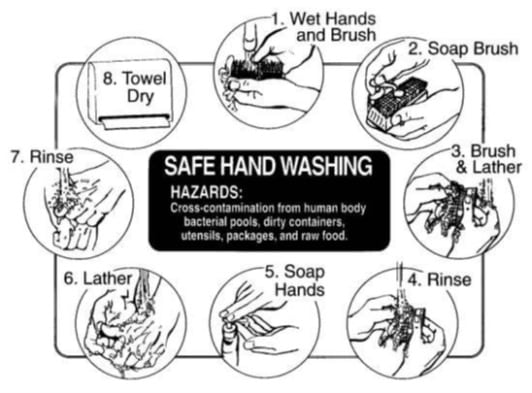
The single hand wash system consists of several steps:
- Wet hands with warm running water, the temperature of the water is for comfort purposes only.
- Ensure only liquid soap is used from a disposable container. Do not use refillable soap containers as mould growth will appear after a period of time.
- Do not use solid bar soap as particles could fall off and act as a physical contaminant and mould growth can also occur.
- Use a soft nylon filament nail brush with an artificial back such as plastic or nylon. Do not use wood as this absorbs moisture and can harbour bacteria. Although food safety legislation does not stipulate using nail brush, it is the best way to clean one’s nails.
- Place some liquid soap on the nail brush and build up lather.
- Brush the front and backs of the nails with the nail brush and under the nails.
- Rinse fingers and nail brush.
- Place liquid soap on the hands.
- Build up a good lather and clean the fronts and packs of hands, between the fingers, both thumbs and all exposed parts of the hands and arms.
- Rinse off soap
- Use paper towel to dry hands.
Always dry your hands after washing as some bacteria will still be present. Scientists have shown that the number of bacteria can be reduced from 100 to 1 between rinsing and paper-towel drying. It is preferable to use paper towels than electric air-dryers or material towels, especially the roller towels, which jam quite often. The electric air-dryers take too long to dry one’s hands and they are not environmentally friendly due to the power consumption and heat from the dryer can permit further bacterial growth on nearby surfaces. Electric dryers also aerosol water and bacteria on the hands, enabling the particulates to become airborne.
A double hand wash system is repeating the process twice. After rinsing hands apply soap to nailbrush and repeat the process. If the taps are hand operated, turn off the taps with the paper towel, to prevent re-contamination of hands.
Do not use bactericidal soaps as they contain chemicals which have been shown to take at least 2 minutes to become effective. The double hand wash system only takes up to 1.5 min and therefore the bactericide is flushed into the water supply, having a damaging effect on the environment’s natural flora and fauna. Do not use alcohol gels as they can cause dermatitis. Also, they are not effective in killing bacteria if the hands are dirty or greasy. Alcohol has a broad-based spectrum which means it kills commensal bacteria as well as pathogens. The more chemicals we use in our fight against pathogens means they will mutate further thus gaining immunity to those chemicals. This is why we have MRSA (Methicillin Resistant Staphylococcus aureus) in hospitals, due to over-prescription/use of antibiotics, which this pathogen has built up immunity to.
Smoking in commercial food areas is illegal, not because of the UK smoking ban, but there are several risks involved, for example, bacteria can be transferred from lips to food or from lips to work surfaces; smoking encourages coughing; there is a risk of physical contamination from the dog end or ash; it creates an unpleasant atmosphere possibly causing coughing from other members of staff.
All illnesses and infections must be reported to the supervisor before returning to work. Examples include:
- Any skin infections.
- Close family contact with family members that may be suffering from food poisoning.
- Any septic cuts all boils that cannot be adequately covered by a dressing.
- If any suspect food has been eaten, ie, you might have eaten the same food as people at a recent gathering. Everybody, apart from you, have contracted food poisoning. It could well be that you are a carrier.
- If suffering from diarrhoea, vomiting or any other signs and symptoms of food poisoning or foodborne disease.
- Ill whilst abroad. This is usually traveller’s diarrhoea which is caused by E. coli. The indigenous population at the holiday destination where the food poisoning was contracted are carriers of pathogenic E. coli.
- All serious bouts of cold or influenza must also be reported as they promote coughing and sneezing.